
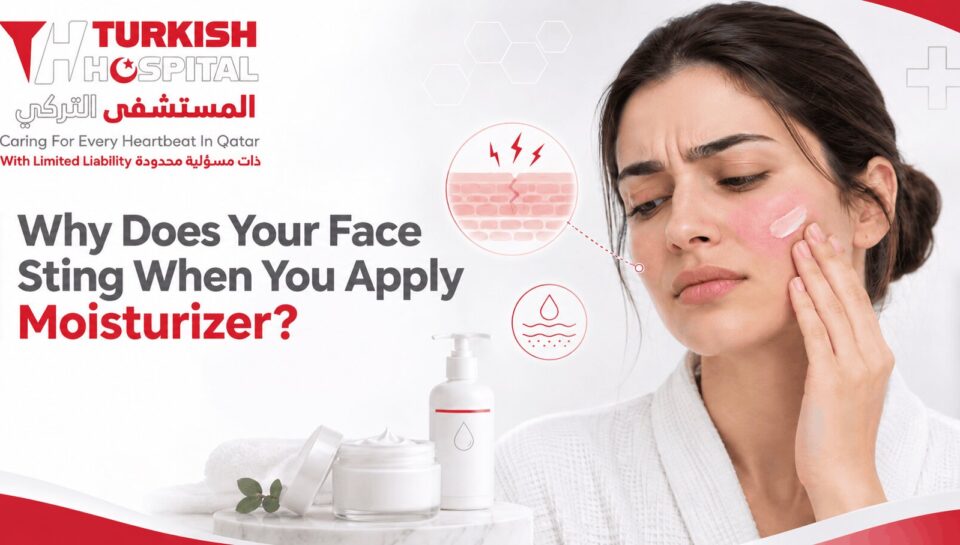
You apply your usual face cream expecting relief, but instead your skin starts burning, tingling, or stinging. If your moisturizer stings face skin that normally feels comfortable, the reaction may be caused by irritation, a weakened skin barrier, or sensitivity to an ingredient.
A moisturizer is supposed to help the skin retain moisture. However, even products advertised for sensitive skin can sometimes cause discomfort.
For people living in Doha, Qatar, environmental dryness, time spent in air-conditioned rooms, and frequent use of skincare products may contribute to skin discomfort in some circumstances.
At Turkish Hospital Qatar, patients with persistent facial irritation can seek dermatology assessment to help identify the possible cause rather than repeatedly changing products without guidance.
Why Does Your Face Sting When You Apply Moisturizer?
Your face may sting when you apply moisturizer because your skin is already irritated, its protective barrier is compromised, or it reacts to an ingredient in the product.
The outermost layer of the skin, called the stratum corneum, helps reduce water loss and protect the skin from external irritants.
When this layer is disrupted, the skin may become more sensitive. Ingredients that were comfortable before may suddenly produce a burning or stinging sensation.
However, not every stinging reaction means the skin barrier is damaged. Some reactions are caused by a specific ingredient, an underlying skin condition, or an allergy.
The timing, severity, appearance, and recurrence of symptoms can help a clinician narrow down the possible cause.
Is It Normal for Moisturizer to Sting?
A brief, mild tingling sensation can occur with certain formulations, especially those containing ingredients such as urea or exfoliating acids.
But repeated or painful stinging should not be ignored.
If a product causes marked burning, redness, itching, swelling, or a visible rash, stop applying it. A product does not need to sting to be effective.
What Causes a Burning Sensation After Moisturizer?
A burning sensation after moisturizer can result from an irritated skin barrier, contact dermatitis, active skincare ingredients, existing skin inflammation, or a combination of factors.
The following table explains common possibilities.
Possible cause | Typical clues | What may help |
Irritated skin barrier | Tightness, dryness, flaking, multiple products suddenly stinging | Simplifying skincare and using a bland, well-tolerated moisturizer |
Irritant contact dermatitis | Burning or stinging after exposure to a harsh cleanser, product, or repeated washing | Avoiding the suspected irritant |
Allergic contact dermatitis | Itchy rash, swelling, or eczema-like changes after exposure to an ingredient | Dermatology assessment and identifying the allergen |
Retinol or exfoliating acids | Peeling, dryness, tenderness, and stinging after introducing active products | Reviewing frequency and product combinations |
Eczema or rosacea | Recurring sensitivity with other characteristic skin symptoms | Assessment and condition-specific treatment |
Dry, cracked, or sun-irritated skin | Stinging over areas that feel rough, inflamed, or tender | Gentle care and protection from further irritation |
These are possible patterns, not a diagnosis. Several skin conditions can produce similar symptoms.
1. Your Skin Barrier May Be Irritated
Your skin barrier is the protective outer layer that limits moisture loss and helps keep irritants out.
When the barrier is disturbed, water can escape more easily. The skin may become dry, tight, flaky, or unusually sensitive.
Possible contributors include:
- Washing the face too frequently
- Using strong or abrasive cleansers
- Over-exfoliating
- Applying multiple active skincare products
- Friction from scrubs or cleansing brushes
- Exposure to harsh environmental conditions
- An existing inflammatory skin condition
A moisturizer may sting because it is being applied to already inflamed skin.
This does not necessarily mean the moisturizer is the original cause of the problem.
2. You May Have Irritant Contact Dermatitis
Irritant contact dermatitis occurs when a substance directly irritates or damages the skin. It does not require an allergy.
Common triggers include harsh soaps, detergents, repeated washing, and certain cosmetics.
Symptoms may include burning, stinging, dryness, redness, scaling, and sometimes painful cracking.
The reaction can occur shortly after exposure or develop over time following repeated contact.
For example, using a strong facial cleanser twice daily and then applying several exfoliating products may gradually increase sensitivity.
When moisturizer is applied afterward, it may be the first product that makes the irritation obvious.
3. You May Have an Allergic Reaction to Face Moisturizer
Allergic contact dermatitis is an immune reaction to a substance that the skin has become sensitized to.
Unlike simple irritation, an allergy can develop even after a product has been used without problems for months or years.
Potential allergens in skincare products include certain fragrances and preservatives.
Symptoms may involve:
- Itching
- A red, brown, purple, or grey rash, depending on skin tone
- Swelling
- Dryness or scaling
- Small blisters
- Persistent or recurrent discomfort
An allergic reaction does not always appear immediately after application. It may develop hours or days after exposure.
This delayed response can make identifying the responsible product difficult.
A dermatologist may recommend formal patch testing when allergic contact dermatitis is suspected. Patch testing is different from trying a small amount of a new cosmetic product at home.
4. You May Be Using Too Many Active Skincare Ingredients
Retinol, retinoids, alpha-hydroxy acids (AHAs), beta-hydroxy acids (BHAs), and other active ingredients can be useful for certain skin concerns.
However, they may also cause dryness or irritation, particularly when products are introduced too quickly or used in unsuitable combinations.
Examples include:
- Starting retinol and an exfoliating acid at the same time
- Applying several exfoliating products in one routine
- Using a scrub on already irritated skin
- Increasing the frequency of active products despite ongoing peeling
If your moisturizer burns after using retinol or exfoliating acids, the discomfort may be related to the skincare routine rather than the moisturizer alone.
Avoid adding more active products in an attempt to fix the problem.
If the irritating product is a prescription treatment, discuss changes with the prescribing clinician.
5. An Underlying Skin Condition May Be Involved
Some skin conditions make the face more reactive to topical products.
Atopic dermatitis, often called eczema, can cause dry, itchy, inflamed skin.
Rosacea may cause facial flushing, persistent redness or changes in skin color, and sensitivity to skincare products.
Other conditions, including certain forms of facial dermatitis, can also cause burning and tenderness.
A person may assume they simply have sensitive skin when the underlying issue is a treatable medical condition.
Persistent symptoms deserve evaluation rather than repeated experimentation with new products.
Why Does My Face Sting After Skincare Products?
Your face may sting after skincare because one product is irritating your skin, several products are being combined, or an existing skin condition is increasing sensitivity.
Sometimes a product becomes uncomfortable only after another product has already irritated the skin.
For example, a cleanser may remove too much of the skin’s natural oil, and an exfoliating serum may increase sensitivity further.
By the time you apply moisturizer, the skin may be inflamed enough to sting.
Why Does Moisturizer Sting After Washing Your Face?
If moisturizer stings immediately after cleansing, the cleansing step may be contributing to the problem.
Possible reasons include:
- Very hot water
- Harsh or heavily fragranced cleansers
- Scrubbing or rubbing the face
- Washing too frequently
- Using exfoliating cleansers on already sensitive skin
For most people, washing gently with lukewarm water and a suitable non-abrasive cleanser is preferable to aggressive cleansing.
The American Academy of Dermatology recommends using fingertips instead of abrasive cloths or scrubbing tools when washing the face.
Why Does My Usual Moisturizer Suddenly Burn?
A product that was comfortable last month may start causing discomfort if your skin’s condition has changed.
For example, you may have recently started retinol, changed cleanser, spent more time outdoors, or developed dermatitis.
An allergy to a product ingredient can also develop after repeated exposure.
Check whether the product’s formula, storage conditions, or expiration status has changed.
Do not assume that a familiar product must always be safe simply because it was previously well tolerated.
How Can You Test a New Skincare Product Safely?
Testing a new skincare product on a small area can help identify some reactions before applying it widely, but it cannot guarantee that the product will never cause irritation or allergy.
For an intact, non-irritated area of skin, the American Academy of Dermatology suggests the following approach:
- Apply a small amount to a discreet test area, such as the inner arm.
- Use the product as directed, usually twice daily for 7–10 days.
- Watch for itching, redness, swelling, or another reaction.
- Stop testing if a reaction develops.
- If the area remains comfortable, introduce the product cautiously into your routine.
Do not deliberately test a product that has already caused a significant reaction.
Home testing is not the same as medical patch testing. Formal patch testing is used by appropriately trained healthcare professionals to investigate suspected allergic contact dermatitis.
Can Qatar’s Climate Make Sensitive Skin Worse?
Qatar’s heat, sun exposure, and dry indoor environments can contribute to skin discomfort in some people, particularly when the skin is already dry or irritated.
Environmental exposure is not necessarily the direct cause of moisturizer stinging. However, it can be part of the wider picture.
Outdoor Heat and Sun Exposure
Strong sun exposure can irritate or damage skin that is not adequately protected.
Sunburned skin may become tender and uncomfortable when topical products are applied.
Use suitable sun protection and avoid excessive sun exposure, particularly when the face is already sensitive.
Air-Conditioned Indoor Environments
Many people in Doha spend significant time in air-conditioned homes, offices, shopping centers, and vehicles.
Some indoor environments have low humidity, which can contribute to skin dryness.
A person who already has eczema or a sensitive skin barrier may notice more discomfort when their skin becomes dry.
Visit Turkish Hospital in Doha for Moisturizer Irritation
If your face burns after applying moisturizer and the problem is not improving, book an appointment with Dr. Latifa Lessel at Turkish Hospital Qatar to discuss your symptoms and next steps.
The hospital’s Dermatology Department provides professional Dermatology Treatment and care for a range of skin conditions, including eczema, contact dermatitis, and cosmetic-product reactions.
You Can Book Your Appointment by:
 Call: +974 4499 2444
 WhatsApp: +974 5027 0444
 Visit: C Ring Road, Building 325, New Salata 21377, Doha, Qatar
 Book Appointment Online