

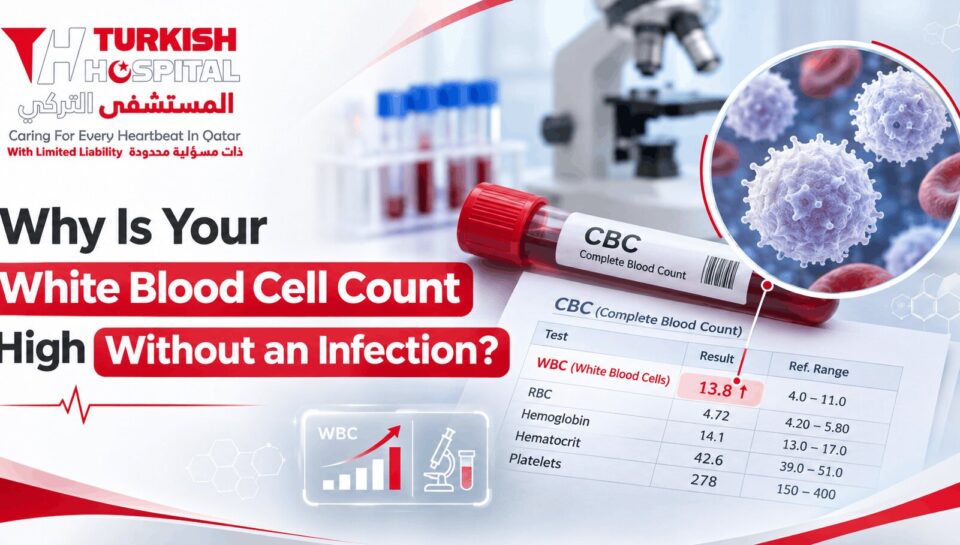
Why is your white blood cell count high when you do not feel sick? Finding high WBC no infection on your mind after receiving blood-test results can be confusing, especially when you have no fever, cough or other obvious symptoms.
A high white blood cell count does not always mean you have an infection. Stress, strenuous exercise, medications, smoking, inflammation and certain medical conditions can also increase white blood cells.
However, having no symptoms does not completely rule out an infection or another underlying condition.
At Turkish Hospital in Doha, laboratory Services helps doctors assess blood-cell counts and understand how individual results relate to a patient’s overall health.
What Does a High White Blood Cell Count Mean?
A high white blood cell count means that the number of white blood cells circulating in your blood is above the reference range used by the testing laboratory. The medical term for this finding is leukocytosis.
White blood cells, also known as leukocytes, form part of the body’s immune system.
They help protect against infections, respond to inflammation and participate in other immune processes.
A white blood cell count is commonly included in a complete blood count, or CBC test.
The CBC also measures red blood cells, hemoglobin and platelets, providing useful information about overall blood health.
What Is the Normal WBC Count in Adults?
For many nonpregnant adults, a typical white blood cell reference range is approximately 4,000–11,000 cells per microliter of blood.
This can also be written as approximately 4.0–11.0 × 10⁹/L.
However, normal ranges vary between laboratories.
Children, pregnant patients and people in certain other clinical circumstances may have different expected values.
Always compare your result with the reference range printed on your own laboratory report.
Is a WBC Count Above 11,000 Always Abnormal?
A WBC count above approximately 11,000 cells/µL is commonly considered elevated in nonpregnant adults, but it is not a universal threshold.
For example, a result of 12,000 cells/µL may represent a mild elevation in one clinical setting.
The significance depends on factors such as your symptoms, age, medications, pregnancy status, previous results and the types of white blood cells that are elevated.
A doctor should not diagnose a disease based solely on a single WBC number.
High WBC No Infection: What Does Your Result Mean?
High WBC without an obvious infection means that your blood contains an increased number of white blood cells, but the reason for the increase has not yet been established.
It may reflect a temporary response to physical stress or medication, an inflammatory condition, or another medical cause.
Importantly, the absence of fever or other infection symptoms does not prove an infection is absent.
Some infections produce subtle symptoms, particularly in older adults and people with weakened immune systems.
Can You Have Elevated White Blood Cells Without Being Sick?
Yes. White blood cell levels can rise after strenuous exercise, surgery, injury or certain medications, even when someone feels well.
This happens because the body can release or redistribute white blood cells in response to different physiological signals.
A temporary increase is not necessarily harmful.
However, an unexplained increase should be reviewed in context, particularly when it persists across multiple blood tests.
What Causes High White Blood Cells Without Infection?
Possible non-infectious causes of high white blood cells include stress, strenuous exercise, corticosteroid medications, chronic inflammation, smoking, pregnancy-related changes and some bone marrow disorders.
Different causes produce different patterns on the blood test.
The following table summarises common possibilities.
Possible cause | Why the WBC count may increase | Useful clinical clues |
Physical stress or intense exercise | Temporary release or redistribution of circulating white blood cells | Recent strenuous activity, injury or surgery |
Corticosteroid medicines | Changes in how white blood cells move between blood vessels and tissues | Recent steroid treatment |
Smoking | Ongoing inflammatory and physiological effects | Current tobacco exposure |
Autoimmune or inflammatory conditions | Persistent immune-system activity | Joint pain, swelling or other inflammatory symptoms |
Allergic or certain parasitic conditions | Possible increase in specific white blood cell types, particularly eosinophils | Allergic symptoms or relevant exposure history |
Pregnancy | Physiological changes may raise WBC counts | Pregnancy-specific reference range |
Bone marrow or blood disorders | Abnormal production or regulation of blood cells | Persistent marked elevation or other abnormal CBC findings |
Infection without obvious symptoms | Immune response to an infection that may not be clinically apparent | Other findings may emerge during medical assessment |
This table does not establish the cause of an individual patient’s result.
1. Can Stress Increase Your White Blood Cell Count?
Yes. Acute physical stress can temporarily increase circulating white blood cells, particularly neutrophils.
Examples include:
- Strenuous exercise
- Major physical exertion
- Surgery
- Trauma or injury
- Acute emotional stress
During a stress response, hormones and other signals can change the movement of white blood cells into the bloodstream.
This may cause a temporary increase on laboratory testing.
However, it is not appropriate to attribute persistent or markedly elevated WBC results to stress without evaluation.
Do not stop prescribed steroid medication or dismiss a possible infection based on WBC results alone. Your prescribing doctor should interpret the findings.
2. Can Smoking Increase White Blood Cells?
Yes. Smoking is associated with increased white blood cell counts in some individuals.
This may be related to chronic inflammatory effects and the body’s response to tobacco exposure.
If your WBC count is elevated, your doctor may ask about cigarette smoking or other relevant exposures.
Smoking-related leukocytosis should not be assumed without considering other possible causes.
Stopping smoking supports overall health, but the reason for a raised WBC count still needs appropriate evaluation.
3. Can Autoimmune Diseases Cause High WBC?
Yes. Certain autoimmune and inflammatory conditions can increase white blood cell counts.
Examples include rheumatoid arthritis and some forms of vasculitis.
These conditions involve immune or inflammatory activity that may influence blood-cell production and circulation.
Symptoms vary depending on the condition.
Some people experience joint swelling, prolonged inflammation, fatigue or other systemic symptoms.
A high white blood cell count alone does not diagnose an autoimmune disease.
4. Can Allergies Raise Your White Blood Cell Count?
Some allergic conditions can increase a specific type of white blood cell called an eosinophil.
Eosinophils are involved in allergic responses and some immune reactions.
An elevated eosinophil count may occur in conditions such as certain allergies, asthma, medication reactions and some parasitic infections.
However, not every allergy causes an elevated total WBC count.
The white blood cell differential is more informative than the total count alone when investigating these possibilities.
5. Can Pregnancy Affect White Blood Cell Counts?
Yes. White blood cell counts can increase during pregnancy as part of normal physiological changes.
WBC levels may also rise around labour and shortly after delivery.
The expected reference range depends on the stage of pregnancy and the clinical circumstances.
Pregnant patients should have results interpreted using suitable pregnancy-related ranges and clinical findings.
Is a Mildly Elevated White Blood Cell Count Serious?
A mildly elevated WBC count is not necessarily serious, but its importance depends on the cause, associated symptoms and whether the elevation is temporary or persistent.
For example, a slight increase after strenuous exercise may have a different explanation from a similar increase that remains present over several months.
A result just above the upper reference limit may not require the same assessment as a much more marked elevation.
Is a WBC Count of 12,000 Dangerous?
A WBC count of 12,000 cells/µL may represent a mild elevation for many nonpregnant adults.
This number alone does not determine whether the condition is dangerous.
Your doctor may consider whether you recently had an infection, started a new medication, exercised intensely or have other relevant medical conditions.
Previous blood-test results can help establish whether the finding is new.
What About a WBC Count of 15,000?
A WBC count of 15,000 cells/µL is above the usual adult reference range in many laboratories.
It can occur with several causes, including infection, stress-related responses, medication effects and inflammatory conditions.
The result needs clinical interpretation, but it does not automatically mean leukemia or another serious blood disorder.
A persistently elevated count, marked changes or abnormalities in other blood cells may increase the need for further investigation.
Why Is My WBC High When I Have No Symptoms?
A high WBC count with no symptoms may represent a temporary physiological response, medication effect or another condition that has not yet produced noticeable symptoms.
Some people discover elevated white blood cells during routine health screening or a preoperative blood test.
The result can be unexpected because the person feels well.
Nevertheless, the absence of symptoms is only one part of the assessment.
Can You Have an Infection Without Fever?
Yes. Not all infections produce fever.
Some infections may cause mild or subtle symptoms, especially early in the illness.
Older adults and certain immunocompromised individuals may not develop the typical signs of infection.
Doctors consider the broader clinical picture rather than using fever alone to determine whether infection is present.
What if Your CRP Is Normal but Your WBC Is High?
C-reactive protein, or CRP, is a blood marker that may increase in response to inflammation.
A normal CRP with elevated WBC does not automatically mean the result is harmless or that infection has been excluded.
CRP and WBC respond differently to illnesses, medications and other physiological changes.
Neither test can independently confirm or rule out every infection or inflammatory condition.
When appropriate, a doctor may use these findings alongside examination and other investigations.
What Does a Persistent High White Blood Cell Count Mean?
Persistent leukocytosis means the WBC count remains elevated on repeated testing. The next step is to determine whether the pattern reflects a continuing reactive cause or another medical condition.
A single mildly elevated result may behave differently from repeatedly abnormal findings over weeks or months.
Doctors often compare previous CBC results to identify trends.
For example, if the WBC count was normal in earlier tests but has recently increased, the timeline may provide useful information.
If it has remained elevated for a long period, the clinician may review smoking history, medication exposure, chronic inflammation and other possible explanations.
Can High White Blood Cells Return to Normal Without Treatment?
Yes. A temporary increase caused by a short-lived physiological response may return to the normal range once that response resolves.
For example, a WBC increase associated with strenuous exercise may not persist.
Similarly, a change associated with medication use may vary as treatment changes under medical supervision.
However, not every elevated count will resolve on its own.
Persistent or unexplained leukocytosis requires assessment to identify whether treatment or monitoring is needed.
How Can Turkish Hospital Help With High WBC Results in Doha?
Turkish Hospital Qatar medical laboratory offers testing and related medical services to support the evaluation of elevated white blood cell counts in patients living in Doha and across Qatar.
An appropriate assessment starts with understanding why the CBC was ordered and how the WBC result relates to the patient’s medical history.
A person with no symptoms and a minor elevation may need a different approach from someone with fever, abnormal platelets or ongoing health concerns.
Dr. Amany Awadallah is a Consultant in Laboratory Medicine & Clinical Pathology at Turkish Hospital Qatar.
You Can Book Your Appointment by:
 Call: +974 4499 2444
 WhatsApp: +974 5027 0444
 Visit: C Ring Road, Building 325, New Salata 21377, Doha, Qatar
 Book Appointment Online