
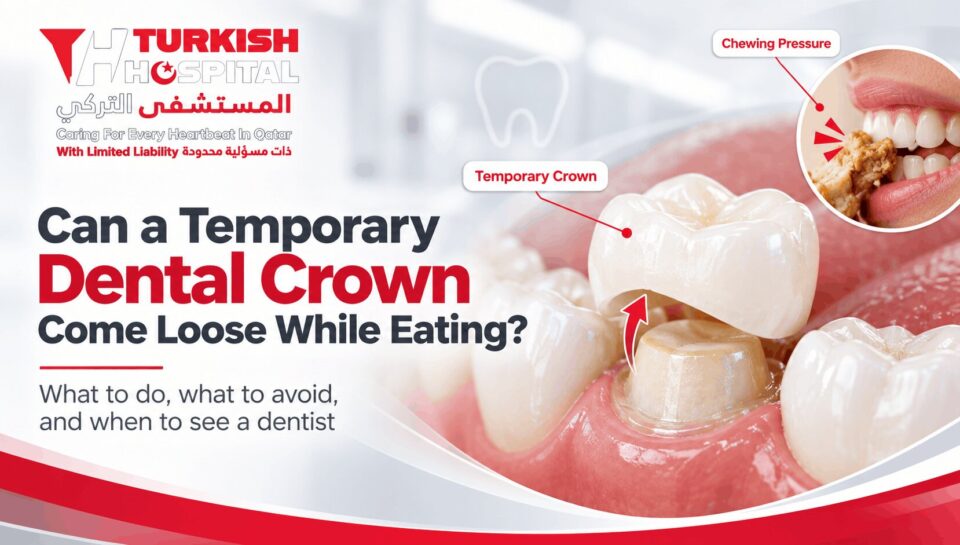
You are enjoying a meal when you suddenly feel something move around one of your teeth. When you check, you realize that your temporary dental crown may have loosened.
If you have a temporary crown loose while eating, it can be uncomfortable and concerning, especially when you are waiting for your permanent crown.
The good news is that temporary crowns can sometimes become loose or fall off during normal activities, and a dentist can often address the problem.
A temporary crown is attached using dental cement that allows the dentist to remove it when the permanent restoration is ready. This means the crown may be more vulnerable to sticky foods, hard foods, or strong chewing forces.
At Turkish Hospital Qatar, our Dental Clinic provides restorative and cosmetic dental services, including dental crowns and professional oral health assessments.
In this guide, we explain why temporary crowns become loose while eating, which foods to avoid, what to do if your crown falls off, and when to seek dental care in Qatar.
What Is a Temporary Dental Crown and Why Is It Used?
A temporary dental crown is a short-term restoration placed over a prepared tooth while a permanent crown is being made. It helps protect the tooth and maintain its shape and position during treatment.
A dental crown is a tooth-shaped covering that fits over a natural tooth to restore its appearance, strength, or function.
In some cases, the permanent crown is made in a dental laboratory, which means it may not be ready during the first appointment.
During this period, a temporary crown serves several important purposes.
Protecting the Prepared Tooth
Before placing a permanent crown, the dentist may need to reshape the natural tooth.
This process can expose areas of the tooth that are more sensitive to temperature and pressure.
A temporary crown helps cover the prepared surface and protect it from everyday irritation.
Maintaining Tooth Position
A temporary crown also helps maintain the relationship between the prepared tooth and its neighboring teeth.
If the temporary restoration is missing for an extended period, small changes in tooth position may affect how the permanent crown fits.
This is one reason dentists recommend contacting them when a temporary crown becomes loose or falls off.
Supporting Everyday Function
A temporary crown may help patients speak and eat more comfortably while waiting for the permanent restoration.
However, temporary crowns are not intended to withstand the same range of forces as a well-fitted permanent crown.
They need additional care during chewing and oral hygiene.
Temporary Crown Loose While Eating: Why Does It Happen?
A temporary crown can become loose while eating because the temporary cement may lose its hold under chewing pressure or when sticky food pulls against the restoration.
Several factors may contribute to the problem.
1. Temporary Dental Cement Has a Different Purpose
Temporary crowns are generally attached using cement designed to allow their later removal.
This is important because the dentist needs to remove the temporary crown without unnecessarily damaging the prepared tooth when the permanent crown is ready.
However, temporary cement may not hold as firmly as cement used for a permanent restoration.
Over time, or under certain biting forces, the bond may weaken.
2. Sticky Foods Can Pull on the Crown
Sticky foods can attach to a temporary crown during chewing.
When you open your mouth, the food may pull against the restoration and increase the chance of loosening it.
Examples include:
- Chewing gum
- Caramel
- Toffee
- Sticky sweets
- Particularly sticky dried fruit
- Very chewy foods
In Qatar, dates are a common part of everyday meals and hospitality. Some date varieties are particularly sticky, so patients wearing temporary crowns may need to avoid chewing them on the treated side.
The issue is not that all dates are harmful to teeth. It is the sticky texture and force required during chewing that may affect a temporary restoration.
3. Hard Foods Can Place Excessive Pressure on the Crown
Hard foods can create concentrated biting forces.
If a temporary crown receives more pressure than it can comfortably tolerate, it may crack, shift, or become dislodged.
Examples include hard nuts, ice, hard sweets, and very crusty bread.
4. Uneven Biting Pressure May Affect Crown Stability
Sometimes, a patient notices that the temporary crown touches the opposing teeth earlier than the surrounding teeth.
This may make the crown feel unusually high when biting.
An uneven bite can place additional pressure on the temporary restoration and the tooth underneath.
If you notice discomfort or an unusual bite, contact your dentist rather than trying to adjust the crown yourself.
5. Teeth Grinding or Clenching May Contribute
People who grind or clench their teeth may place additional forces on their dental restorations.
These forces can occur during sleep or while concentrating during the day.
If you regularly grind your teeth, tell your dentist so they can consider this factor when assessing the temporary crown.
What Foods Should You Avoid With a Temporary Crown?
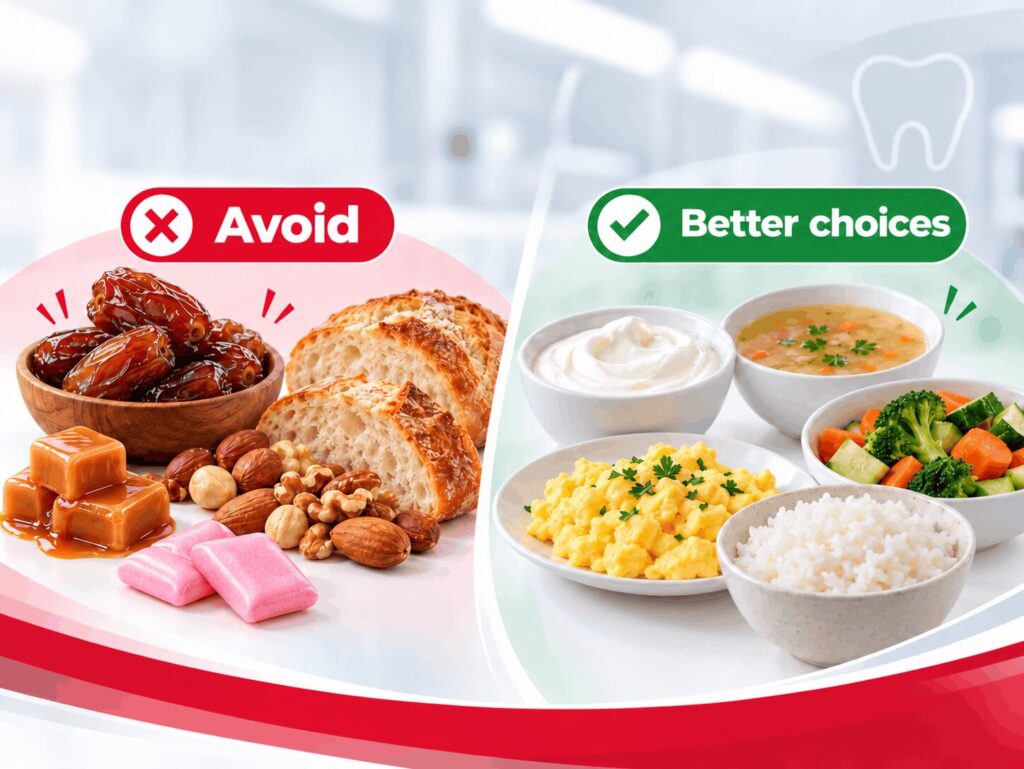
The main foods to avoid with a temporary crown are hard, sticky, and very chewy foods. These foods can pull on the restoration or create pressure that may loosen or damage it.
Choosing easier-to-chew foods can help protect the crown until your permanent restoration is ready.
Hard and Crunchy Foods
Avoid biting directly on very hard foods with the temporary crown.
Examples include hard sweets, ice cubes, hard nuts, and particularly crusty bread.
If a food normally requires strong biting pressure, ask your dentist whether it is suitable during your temporary crown period.
Sticky and Chewy Foods
Sticky foods can create a pulling force when you chew.
This makes foods such as chewing gum, caramel, and chewy sweets unsuitable for many patients with temporary crowns.
Some dried fruits and tough foods may also require additional caution.
What Can You Eat With a Temporary Crown?
Softer foods are generally easier to manage, provided your dentist has not given you different instructions.
Examples may include:
- Soft rice
- Yoghurt
- Scrambled eggs
- Soft, cooked vegetables
- Tender, finely cut chicken
- Soft pasta
- Smooth soups that are not excessively hot
The safest food choice depends on the tooth being treated and your dentist’s instructions.
Foods to Avoid vs Easier Alternatives
Foods to avoid or approach cautiously | Generally easier alternatives |
Hard nuts | Soft cooked vegetables |
Chewing gum | Yoghurt |
Sticky sweets | Soft, non-sticky fruit |
Very crusty bread | Soft bread |
Tough meat | Tender, finely cut chicken |
Hard sweets | Soft foods that require little chewing |
Very sticky dates | Softer, less sticky alternatives, eaten away from the treated side |
Even with soft foods, try to chew on the opposite side of your mouth when possible.
If your mouth is still numb after dental treatment, wait until the numbness has worn off before eating to reduce the risk of accidentally biting your cheek or tongue.
What Should You Do if Your Temporary Crown Falls Off While Eating?
If your temporary crown falls off while eating, stop chewing, retrieve the crown if possible, protect the exposed tooth, and contact your dentist promptly.
Do not ignore the problem simply because the tooth is not painful.
Step 1: Stop Eating and Check Your Mouth
Stop chewing as soon as you notice the crown moving or coming off.
Carefully check whether the crown is still in your mouth.
If you can safely remove it, take it out rather than continuing to chew.
Be careful not to bite or swallow the loose restoration.
If you experience coughing, choking, or breathing difficulty after the crown disappears, seek emergency medical attention immediately because inhalation is possible.
Step 2: Keep the Temporary Crown Safe
If you retrieve the crown, rinse it gently with clean water if necessary.
Place it in a clean, secure container.
Do not scrub it aggressively, change its shape, or try to remove material from inside it with sharp objects.
Bring the crown to your dental appointment because your dentist may be able to assess whether it can be reused.
Step 3: Avoid Chewing on the Exposed Tooth
A tooth prepared for a crown may be sensitive to hot, cold, or sweet foods.
Until your dentist provides advice, avoid chewing on the affected side.
Choose soft foods and be careful with very hot or cold drinks if they cause discomfort.
Do not pick at the prepared tooth with your fingers or other objects.
Step 4: Keep the Area Clean
Continue maintaining oral hygiene, but clean the exposed tooth carefully.
A gentle rinse with clean water can help remove food particles.
Do not aggressively brush sensitive areas or attempt to repair the restoration yourself.
If the gum is sore or the tooth feels unusually sensitive, explain these symptoms when you contact your dentist.
Step 5: Contact Your Dentist as Soon as Possible
Call your dentist and explain that the temporary crown has become loose or fallen off.
The dental team can advise whether you need prompt examination, recementation, or a replacement temporary crown.
Do not use household glue, superglue, or other non-dental adhesives.
Temporary dental cement products may be available in some pharmacies, but patients should seek professional guidance before attempting any temporary reattachment. An incorrectly fitted or insecure crown can create additional problems.
Need help with a loose temporary dental crown?
If your temporary crown has fallen off while eating in Doha, you can contact the Dental Hospital at Turkish Hospital Qatar for guidance and an appropriate assessment.
Can You Continue Eating With a Loose Temporary Crown?
It is not advisable to continue chewing with a temporary crown that is moving or no longer securely attached. Continued chewing may dislodge the crown completely, damage it, or expose the tooth underneath.
If the restoration feels loose, stop using that side of your mouth.
Why Is Chewing With a Loose Crown Risky?
A loose crown may move when you bite.
This movement can create discomfort or cause the restoration to detach unexpectedly.
A significantly loose crown may also present a swallowing or choking risk if it separates during eating.
The exposed tooth underneath may be vulnerable to pressure, food irritation, and temperature sensitivity.
What Should You Eat While Waiting for Dental Advice?
If you must eat before your dental appointment, choose soft foods and chew away from the affected tooth where possible.
Avoid hard, sticky, and very chewy foods.
Do not sleep with an insecure, loose crown in your mouth. Ask your dentist for advice about safely managing the restoration until it can be secured.
How Can You Prevent a Temporary Crown From Falling Off?
You can reduce the chance of a temporary crown becoming loose by following your dentist’s aftercare instructions, avoiding hard and sticky foods, and keeping the area clean.
These precautions do not eliminate every risk, but they help protect the restoration during the temporary period.
Choose Soft Foods and Take Smaller Bites
Eat slowly and cut food into manageable pieces.
Avoid biting directly into hard or particularly chewy foods with the temporary crown.
Smaller bites may help reduce unnecessary force on the restoration.
Chew on the Opposite Side When Possible
If the temporary crown is on one side of your mouth, chewing on the other side may reduce direct pressure.
This is especially helpful during the first few days or when the treated tooth is sensitive.
Follow your dentist’s specific guidance about eating after the procedure.
Brush and Floss Carefully
Continue keeping your teeth and gums clean.
Use a soft toothbrush and avoid aggressive pressure around the temporary restoration.
When flossing beside a temporary crown, follow your dentist’s instructions. Dentists may advise sliding the floss out sideways rather than pulling it upward, which could accidentally lift the temporary crown.
Do not stop all cleaning around the area unless your dentist specifically advises otherwise.
Avoid Using Your Teeth to Open Objects
Do not bite fingernails, pens, packaging, or other hard objects.
These habits place unnecessary pressure on both temporary and permanent dental restorations.
Attend Your Permanent Crown Appointment
A temporary crown is intended for short-term use.
Do not delay your permanent crown appointment without discussing it with your dental team.
The dentist will remove the temporary restoration and assess the permanent crown’s fit, bite, and appearance before final placement.
Temporary Crown vs Permanent Crown: What Is the Difference?
A temporary crown protects a prepared tooth during treatment, while a permanent crown is designed as a longer-term restoration. Their materials, retention methods, and expected functions may differ.
Feature | Temporary crown | Permanent crown |
Purpose | Short-term protection | Longer-term restoration |
Material | Often resin or other provisional material | May be ceramic, metal, or other dental materials |
Cement | Designed to allow later removal | Selected for longer-term retention |
Durability | Usually less resistant to chewing stress | Designed for normal function after placement |
Food precautions | Additional care with hard and sticky foods | Normal eating may resume as directed, with sensible precautions |
Follow-up | Requires planned replacement | Requires ongoing dental care and monitoring |
A permanent crown is not indestructible and still requires good oral hygiene and appropriate dental follow-up.
For information about one permanent restoration option, read about Zirconia Crowns.
Visit Turkish Hospital Dental Clinic
Seek urgent dental attention if you develop severe or worsening tooth pain, facial swelling, fever with dental symptoms, or signs of a possible dental infection.
The Dental Center at Turkish Hospital Qatar provides dental examinations, restorative dentistry, dental crowns, and other dental services.
You Can Book Your Appointment by:
 Call: +974 4499 2444
 WhatsApp: +974 5027 0444
 Visit: C Ring Road, Building 325, New Salata 21377, Doha, Qatar
 Book Appointment Online