

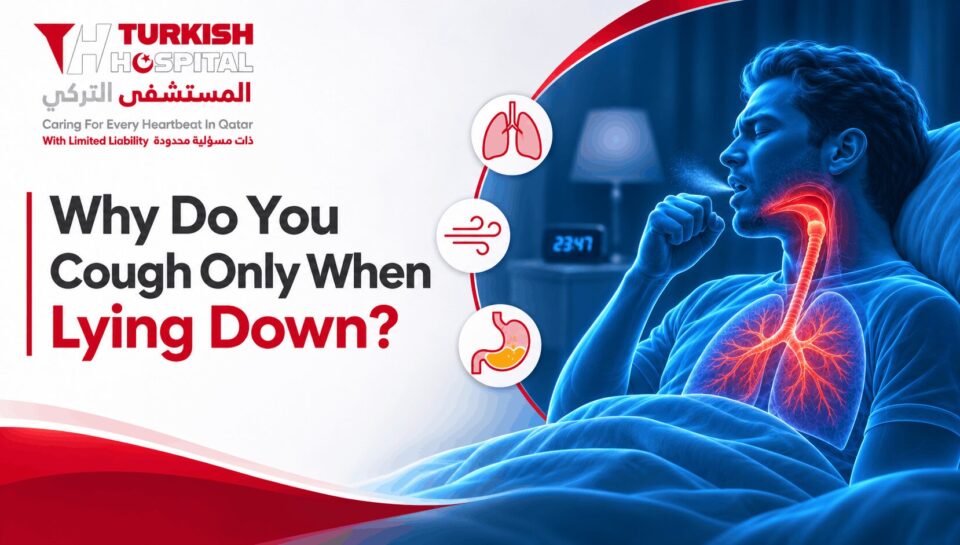
Do you feel perfectly fine during the day but start coughing as soon as you get into bed? A cough when lying down can be frustrating, especially when it interrupts sleep or repeatedly wakes you at night.
This pattern may occur because lying flat allows stomach contents to reflux, changes how mucus collects in the throat, or makes certain respiratory symptoms more noticeable. Asthma, environmental irritants, infections and, occasionally, heart conditions can also contribute.
For people living in Doha, Qatar, bedroom allergens, air conditioning and outdoor dust exposure may be additional factors.
At Turkish Hospital, the Pulmonology Department evaluates persistent coughing and breathing-related symptoms to help determine the underlying cause.
Understanding why your cough changes with body position can help you recognise important warning signs and know when professional assessment is needed.
Why Do I Cough When I Lie Down?
You may cough when you lie down because changes in body position affect mucus drainage, make acid reflux more likely, or aggravate sensitive airways.
Coughing is a protective reflex. It helps clear mucus, particles and irritants from the respiratory tract.
When you stand or sit upright, gravity affects how mucus and stomach contents move. When you lie flat, these effects change.
For example, mucus from the nose and sinuses may become more noticeable at the back of the throat. Stomach contents may also move upward more easily in people who experience reflux.
Some conditions, including asthma, naturally cause symptoms that vary throughout the day and night.
Why Does Coughing Start Immediately After Lying Flat?
A cough that starts soon after you lie down may be associated with reflux, throat irritation, postnasal drip or an already sensitive airway.
The timing can provide a useful clue, but it cannot confirm a diagnosis.
Ask yourself:
- Does the cough begin immediately or after you have been asleep?
- Do you experience a sour taste, heartburn or frequent throat clearing?
- Do you notice wheezing or chest tightness?
- Is your cough dry or accompanied by mucus?
- Does sitting upright make your symptoms improve?
- Do you also feel short of breath when lying flat?
These details can help a clinician decide what to investigate.
What Causes Coughing When Lying Down at Night?
Common causes of coughing when lying down at night include upper-airway cough syndrome (often associated with postnasal drip), gastroesophageal reflux, asthma and respiratory infections.
Other possibilities include airway irritation from environmental exposures, medication effects and some heart or lung conditions.
The accompanying symptoms are often more informative than the cough alone.
Possible cause | Symptoms that may occur | Why nighttime or lying flat may matter |
Postnasal drip | Mucus in throat, throat clearing, nasal congestion | Changes in mucus drainage may irritate the throat |
Acid reflux or GERD | Sour taste, heartburn, hoarseness, or sometimes no typical reflux symptoms | Reflux may occur more easily while lying down |
Asthma | Cough, wheezing, chest tightness, shortness of breath | Airways may become more reactive at night |
Bedroom allergens | Sneezing, itchy eyes, nasal symptoms, coughing | Exposure may increase during time spent in bed |
Respiratory infection | Cough, fever, sore throat, tiredness, mucus | Airway inflammation may continue and be more noticeable at night |
Medication-related cough | Persistent dry cough after starting certain medicines | The cough may be noticeable at bedtime without being caused by posture |
This table describes possible patterns, not a method of self-diagnosis.
1. Postnasal Drip and Mucus in the Throat
Postnasal drip occurs when mucus from the nose or sinuses moves down the back of the throat. It can trigger frequent throat clearing and coughing, especially when lying down.
Your nose and sinuses naturally produce mucus. Normally, you swallow much of it without noticing.
When mucus production increases or the tissues become irritated, you may feel something collecting in your throat.
Possible contributors include:
- Allergic rhinitis
- A cold or other upper respiratory infection
- Sinus inflammation
- Exposure to dust or other irritants
You might also notice nasal congestion, sneezing, a tickling sensation or frequent throat clearing.
Clinicians sometimes use the broader term upper-airway cough syndrome because cough related to nasal and throat conditions is not always explained by visible mucus alone.
Treating the underlying nasal condition may reduce coughing, but the correct approach depends on the cause.
2. Acid Reflux and GERD
Acid reflux may contribute to a cough when lying down because stomach contents can move upward into the esophagus and sometimes irritate the throat.
Gastroesophageal reflux disease, or GERD, occurs when reflux causes troublesome or repeated symptoms or complications.
Typical symptoms may include heartburn, regurgitation and a sour taste.
However, some people report throat clearing, hoarseness or coughing without obvious heartburn.
The term silent reflux is sometimes used for reflux associated with throat symptoms, although throat symptoms alone do not prove reflux is the cause.
Clues that may prompt assessment include:
- Coughing after a large evening meal
- Symptoms that begin after lying down
- A sour or acidic taste
- Repeated throat clearing
- Hoarseness, particularly in the morning
Not every nighttime cough is caused by GERD.
According to the American College of Chest Physicians, reflux-related cough should be evaluated alongside other common causes of chronic cough. Acid-suppressing medication should not automatically be used for every cough without evidence of a reflux-related problem.
3. Asthma and Cough-Variant Asthma
Asthma can cause coughing at night because the airways become inflamed and overly sensitive. Some people have cough-variant asthma, where coughing is the main symptom.
You do not always need to hear wheezing to have asthma.
Other possible symptoms include:
- Chest tightness
- Breathlessness
- Cough after exercise
- Symptoms triggered by dust, cold air or strong smells
- Repeated coughing that disrupts sleep
Symptoms may vary from day to day.
A pulmonologist Clinic may recommend spirometry or other tests when asthma is suspected.
Do not begin or change prescribed asthma treatment based only on online symptom lists.
4. Allergens and Irritants in the Bedroom
Dust mites, mold, pet allergens, tobacco smoke and other airborne irritants can aggravate nighttime coughing in people with sensitive airways or respiratory allergies.
A bedroom may contain allergens that are less noticeable during the day.
Possible sources include bedding, upholstered furniture, carpets, indoor dampness and pets.
Not everyone is allergic to these exposures.
However, people with allergic rhinitis or asthma may notice coughing or nasal symptoms after spending time in particular indoor environments.
If symptoms occur mainly in one room, consider whether an environmental factor could be contributing.
Avoid unnecessary exposure to smoke and strong fragrances, especially if they trigger respiratory symptoms.
5. Respiratory Infections and Lingering Airway Irritation
Respiratory infections can cause a cough that becomes more noticeable at night, even after other symptoms begin to improve.
Colds and other viral illnesses can leave the airways temporarily sensitive.
You may experience coughing, throat irritation, mucus or an urge to cough when breathing deeply.
Most uncomplicated acute coughs improve without specific treatment, although recovery time varies.
A cough that lasts longer than expected, becomes progressively worse, or is accompanied by fever, chest pain or breathing difficulty should be assessed.
Antibiotics do not treat most viral causes of coughing and should only be used when medically indicated.
Why Do I Have a Dry Cough When Lying Down?
A dry cough when lying down may be caused by asthma, reflux, a recent respiratory infection, environmental irritants or medication effects.
A dry cough is one that does not produce noticeable mucus or phlegm.
People sometimes assume that a dry cough is harmless because no mucus is present.
However, cough type alone does not determine severity.
Can You Have a Nighttime Cough Without a Cold?
Yes. Allergic rhinitis, asthma, reflux and other non-infectious conditions may cause repeated coughing without fever or typical cold symptoms.
For example, someone with cough-variant asthma may experience a recurring dry cough but very little wheezing.
Another person may cough after eating and lying down because reflux is contributing to throat irritation.
These patterns help guide medical questions but are not sufficient for diagnosis.
When Should You See a Pulmonologist at Turkish Hospital in Doha?
You should consider seeing a pulmonologist if nighttime coughing keeps returning, interrupts sleep, lasts for several weeks, or occurs with wheezing, chest tightness or unexplained breathing symptoms.
A pulmonologist is a doctor who specialises in diseases of the lung specialist, airways and respiratory system.
Is your cough disrupting sleep or returning every night? Schedule an appointment with Dr Hazem Moursi at Turkish Hospital Qatar for an individual respiratory assessment.
You Can Book Your Appointment by:
 Call: +974 4499 2444
 WhatsApp: +974 5027 0444
 Visit: C Ring Road, Building 325, New Salata 21377, Doha, Qatar
 Book Appointment Online