
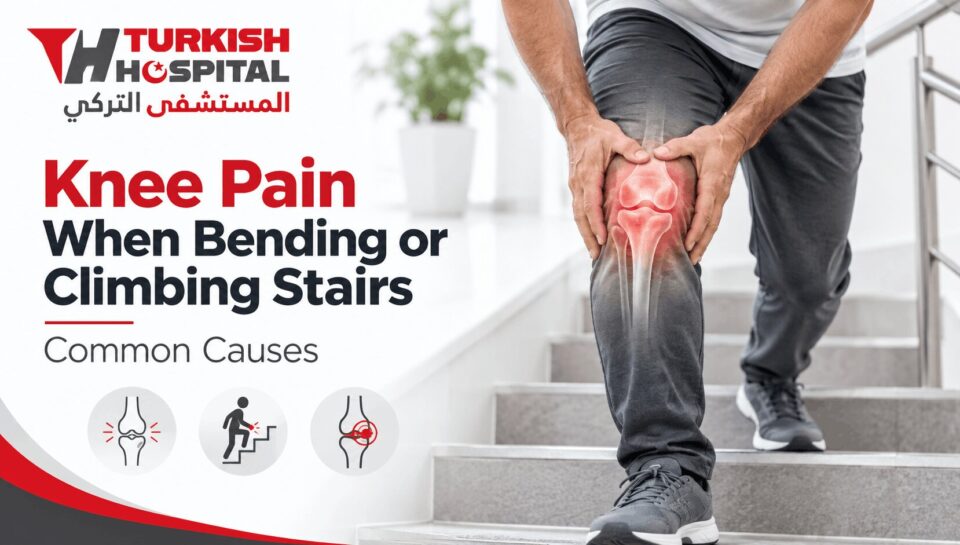
Knee Pain When Bending or Climbing Stairs | Common Causes
Knee pain when bending can make everyday movements such as climbing stairs, sitting down, standing up, squatting, kneeling, or getting in and out of a car uncomfortable. The pain may develop gradually or appear after exercise, a sports injury, a sudden twist, or increased physical activity.
For patients in Doha, Qatar, knee pain while climbing stairs does not point to one single diagnosis. Possible causes include patellofemoral pain, knee arthritis, meniscus problems, tendon irritation, overuse, and other conditions affecting the structures around the knee.
At Turkish Hospital Qatar, knee symptoms can be assessed according to the location of the pain, how it started, movements that trigger it, physical examination findings, and imaging when clinically appropriate.
Key Takeaways
Question | Quick Answer |
Why does my knee hurt when bending? | Bending increases load on several structures in and around the knee. Patellofemoral pain, arthritis, meniscus injuries and tendon problems are possible causes. |
Why does stair climbing hurt? | Climbing and descending stairs require repeated knee bending while the joint supports body weight. |
What does front knee pain commonly suggest? | Pain around or behind the kneecap can occur with patellofemoral pain, although other conditions can cause similar symptoms. |
Is pain going downstairs different? | Descending requires the thigh muscles to control the body as the knee bends, which can make some kneecap-related symptoms more noticeable. |
Does knee pain always require surgery? | No. Many causes can be treated without surgery, depending on the diagnosis and severity. |
When should knee pain be assessed? | Persistent pain, significant swelling, locking, instability, inability to bear weight, or symptoms after an injury should be medically evaluated. |
Why Does My Knee Hurt When I Bend It?
Knee pain when bending occurs because bending changes the pressure and load placed on the kneecap, cartilage, menisci, tendons, ligaments, muscles, and other structures around the joint. The exact cause depends on where the pain occurs, how it started, and whether symptoms such as swelling, stiffness, catching, or instability are also present.
The knee is not simply a hinge. The kneecap, or patella, moves along a groove at the end of the thigh bone each time the knee bends and straightens.
Activities that repeatedly bend the knee, including climbing stairs, squatting, running and jumping, are commonly associated with symptoms of patellofemoral pain. Difficulty climbing stairs and discomfort during repeated knee bending can occur with this condition.
However, not everyone with pain while bending has patellofemoral pain. An examination may be necessary to identify the source.
What Are the Common Causes of Knee Pain When Bending?
The most common causes of knee pain when bending include patellofemoral pain, osteoarthritis, meniscus injuries, tendon problems, overuse, and other musculoskeletal conditions. Symptoms can overlap, which is why the movement that causes pain should not be used alone to diagnose the condition.
1. Patellofemoral Pain
Patellofemoral pain is one of the most common explanations for front knee pain that becomes more noticeable during activities involving repeated bending.
The pain is usually felt around or behind the kneecap.
People may notice discomfort when:
- Going up stairs
- Going down stairs
- Squatting
- Running
- Jumping
- Kneeling
- Standing after sitting
- Sitting for a long time with the knees bent
Patellofemoral pain is sometimes called runner’s knee, although it can affect people who do not run or participate in sport.
Overuse, rapid increases in physical activity, muscle weakness or imbalance, and changes in how the kneecap tracks may contribute to symptoms. Repeated stress and sudden changes in training intensity can also aggravate the structures around the kneecap.
2. Knee Osteoarthritis
Knee osteoarthritis can cause pain, stiffness and reduced mobility that become noticeable during bending, walking and stair climbing.
Osteoarthritis involves changes in the cartilage and other structures within the joint. Symptoms can develop gradually.
Possible symptoms include:
- Knee pain during activity
- Stiffness after rest
- Swelling
- Reduced movement
- Difficulty climbing stairs
- Discomfort when getting out of a chair
- Pain when kneeling or squatting
Arthritis affecting the patellofemoral part of the knee can particularly cause pain during stair climbing, descending stairs, squatting or sitting with the knee bent.
Age can increase the likelihood of osteoarthritis, but knee pain should not automatically be dismissed as a normal part of getting older.
3. Meniscus Injury
A meniscus tear may cause knee pain during bending or twisting, particularly when the pain is accompanied by swelling, catching, locking or restricted movement.
Each knee contains two menisci. These pieces of fibrocartilage help distribute load and contribute to knee stability.
A meniscus can be injured during a twisting or pivoting movement. Degenerative tears can also develop as the tissue changes with age.
Symptoms may include:
- Pain
- Swelling
- Stiffness
- Catching
- Knee locking
- Difficulty fully bending or straightening the knee
- A feeling that the knee may give way
Pain, swelling, catching, locking, giving way, and reduced range of movement can occur with a meniscus tear.
Not every meniscus tear requires surgery. Treatment depends on the type of tear, symptoms, examination findings and individual circumstances.
4. Patellar or Quadriceps Tendon Problems
Tendons around the front of the knee can become irritated or injured through repetitive loading, sport, jumping or sudden changes in activity.
The quadriceps tendon connects the thigh muscles to the kneecap, while the patellar tendon connects the kneecap to the shin bone.
Pain related to these structures may be felt:
- Above the kneecap
- Below the kneecap
- During stairs
- During jumping
- During squatting
- When rising from a seated position
The location and pattern of pain can help guide the clinical examination, but symptoms should not be self-diagnosed based on location alone.
5. Overuse or a Sudden Increase in Activity
Sometimes knee pain begins after the joint has been exposed to more load than it is accustomed to.
Examples include:
- Starting a new gym routine
- Increasing running distance
- Playing more football or padel
- Repeated stair climbing
- Increasing squat or lunge training
- Returning to sport after inactivity
- Changing training surface or footwear
Patellofemoral symptoms, for example, can appear after changes in training frequency, duration or intensity.
Reducing aggravating activity temporarily may help in some cases, but persistent or worsening symptoms should be assessed.
Why Does My Knee Hurt Going Up Stairs?
Knee pain going up stairs can occur because stair climbing requires the knee to bend while the quadriceps muscles generate force to lift the body upward.
This movement places more demand on the knee than ordinary level walking.
Conditions that may become noticeable when going upstairs include:
- Patellofemoral pain
- Knee osteoarthritis
- Patellar tendon problems
- Quadriceps tendon problems
- Meniscus problems
- Muscle weakness or reduced control after injury
The exact location can provide useful clues.
Pain around or behind the kneecap may be associated with the patellofemoral joint. Pain along the inner or outer joint line, particularly with catching or locking, can raise different clinical considerations.
A physical examination is important because several knee conditions can cause similar pain patterns.
Why Does My Knee Hurt Going Down Stairs?
Knee pain going down stairs may feel worse because the quadriceps muscles have to control the body’s descent while the knee remains bent under load.
Instead of simply pushing the body upward, the muscles must control and slow the body as each foot moves to the next step.
This can make symptoms around the kneecap particularly noticeable.
Both ascending and descending stairs can aggravate patellofemoral pain in some patients.
If you have knee pain going down stairs but relatively little discomfort when walking on a flat surface, the pattern is useful information to give your doctor. It does not, by itself, confirm a diagnosis.
What Does Front Knee Pain While Climbing Stairs Mean?
Front knee pain during stair climbing frequently involves structures around the kneecap, but an examination is needed to determine the exact cause.
Patellofemoral pain is commonly felt around or behind the patella and can become worse with:
- Stair climbing
- Squatting
- Kneeling
- Running
- Jumping
- Long periods of sitting
Some patients also notice clicking, popping or grinding.
These sounds do not automatically mean that serious damage is present. Clicking or grinding can occur with patellofemoral pain and does not necessarily indicate significant joint damage.
Painful clicking associated with swelling, locking, instability, or an injury should be assessed separately.
Can Knee Pain While Climbing Stairs Be a Meniscus Tear?
A meniscus injury can cause pain with bending, squatting and other loaded movements, but stair pain alone is not enough to diagnose a meniscus tear.
A meniscus problem becomes more important to consider when knee pain develops after:
- Twisting
- Pivoting
- Sudden direction changes
- Sports activity
- A traumatic knee injury
Other symptoms may include:
- Swelling
- Joint-line pain
- Catching
- Locking
- Giving way
- Difficulty fully bending or straightening the knee
Some people can still walk after a meniscus tear, so the ability to walk does not rule one out. Stiffness, swelling, catching, locking and restricted movement can occur after a meniscus injury.
Turkish Hospital’s Orthopaedics and Traumatology service includes assessment and treatment of knee conditions, meniscal tears, arthritis and degenerative knee changes, with arthroscopic procedures available for selected conditions when clinically indicated.
How Is Knee Pain When Bending Diagnosed?
Diagnosis starts with understanding where the knee hurts, when symptoms began, what movements trigger them, and whether there was an injury.
Your doctor may ask:
- Is the pain in front, behind, inside or outside the knee?
- Did symptoms begin suddenly or gradually?
- Was there a twisting injury?
- Does the knee swell?
- Does it lock or catch?
- Does it feel unstable?
- Is going up or down stairs worse?
- Does sitting with the knee bent cause discomfort?
- Have your exercise or sports habits recently changed?
- Have you had a previous knee injury?
The knee may then be examined for tenderness, swelling, stability, range of movement, strength and other clinical findings.
Do You Always Need an MRI for Knee Pain?
No. Not every person with knee pain when bending needs an MRI. Imaging is selected according to the suspected condition and the findings from the history and physical examination.
Depending on the situation, a doctor may consider:
- X-ray
- MRI
- Other imaging where clinically appropriate
For example, an X-ray does not directly show a meniscus tear, but it can help identify other causes of knee symptoms such as osteoarthritis. MRI may be used when a soft-tissue injury such as a meniscus tear is suspected and imaging is clinically necessary.
Turkish Hospital’s Radiology and Imaging service includes X-ray and MRI services that can support musculoskeletal assessment when requested by the treating physician.
How Is Knee Pain When Bending Treated?
Treatment depends on the cause of the knee pain rather than the symptom alone. Many knee conditions can initially be managed without surgery.
Depending on the diagnosis, management may include:
Activity Modification
Temporarily reducing movements that repeatedly aggravate symptoms can help some knee problems settle.
This does not necessarily mean complete inactivity. The appropriate activity level depends on the condition.
Exercise and Physiotherapy
Targeted rehabilitation may focus on:
- Quadriceps strength
- Hip strength
- Knee control
- Flexibility
- Range of motion
- Gradual return to activity
Exercise therapy may be recommended for conditions such as patellofemoral pain, with treatment often focusing on strengthening and improving control around the knee and hip.
Turkish Hospital’s Physiotherapy service provides rehabilitation for orthopaedic conditions and sports injuries, including individualized exercise programs.
Pain Management
Medication may sometimes be considered to manage pain or inflammation, depending on the patient’s medical history and diagnosis.
Patients should discuss medication use with an appropriate healthcare professional, particularly when they have other medical conditions or take other medicines.
Weight Management When Relevant
For patients who are overweight, reducing excess load on the knee may form part of an overall treatment plan for some conditions, particularly osteoarthritis.
Injections
Some knee conditions may be managed with injection-based treatments when clinically appropriate.
Whether an injection is suitable depends on the diagnosis and should be determined after medical assessment.
Surgery
Surgery is not automatically required because a patient has knee pain.
Some structural injuries or persistent conditions may require surgical treatment after assessment. Turkish Hospital’s current Orthopaedics and Traumatology service includes selected knee arthroscopy procedures, including arthroscopic treatment for meniscal tears, loose-body removal, washout and debridement when clinically indicated.
When Should You See an Orthopaedic Doctor in Doha, Qatar?
Knee pain should be medically assessed when it persists, worsens, limits normal activities, or occurs with significant swelling, instability, locking or reduced movement.
Arrange an assessment if:
- Knee pain continues despite reducing aggravating activities
- Stair climbing becomes increasingly difficult
- The knee repeatedly swells
- The knee locks or catches
- The knee gives way
- You cannot fully bend or straighten it
- Pain developed after a sports injury or twisting movement
- Symptoms interfere with work, sleep, exercise or everyday mobility
More urgent evaluation may be needed if:
- You cannot bear weight on the affected leg
- There is a significant deformity
- Severe pain follows a major injury
- The knee becomes very swollen
- The knee is red, hot and swollen, particularly with fever or feeling unwell
These findings can require prompt medical evaluation.
Knee Care in Doha at Turkish Hospital Qatar
Knee pain when bending, knee pain going up stairs, knee pain going down stairs, and persistent front knee pain can have several possible causes. The movement that triggers symptoms provides useful information, but an accurate diagnosis depends on the wider clinical picture.
If knee pain while climbing stairs is continuing, worsening or interfering with your normal activities, an orthopaedic assessment can help determine whether the problem is related to the kneecap, meniscus, arthritis, tendon, injury or another cause.
Book Your Appointment
Book your appointment with Dr. Vedat Burkay Camurdan or Dr. Omer Ozel at Turkish Hospital Qatar today.
📞 Call: +974 4499 2444
💬 WhatsApp: +974 5027 0444
📧 Email: info@turkishhospitals.com
📍 Visit: C Ring Road, Building 325, New Salata 21377, Doha, Qatar
🔗 Book Appointment Online
Frequently Asked Questions About Knee Pain When Bending
Why does my knee hurt when I bend it but not when I walk?
The location of the pain and additional symptoms such as swelling, clicking, locking or stiffness help determine what should be assessed.
Why does my knee hurt when going up stairs?
Patellofemoral pain is particularly associated with activities involving repeated knee bending, including stair climbing.
Why does my knee hurt more going down stairs than going up?
Pain that occurs mainly while descending stairs is useful clinical information, but it does not confirm a particular diagnosis.
What causes pain in the front of the knee when bending?
Because different conditions can produce similar symptoms, persistent pain should be assessed rather than diagnosed from pain location alone.
Is walking good for knee pain?
If walking causes increasing pain, swelling, instability or other symptoms, reduce the activity and seek professional advice. Lower-impact activities may sometimes be recommended as part of an individualized treatment plan.
Medical Disclaimer
This article is provided for general informational and educational purposes only. It is not intended to diagnose a medical condition or replace individual medical advice, examination, diagnosis or treatment from a qualified healthcare professional.